JUNE 2026
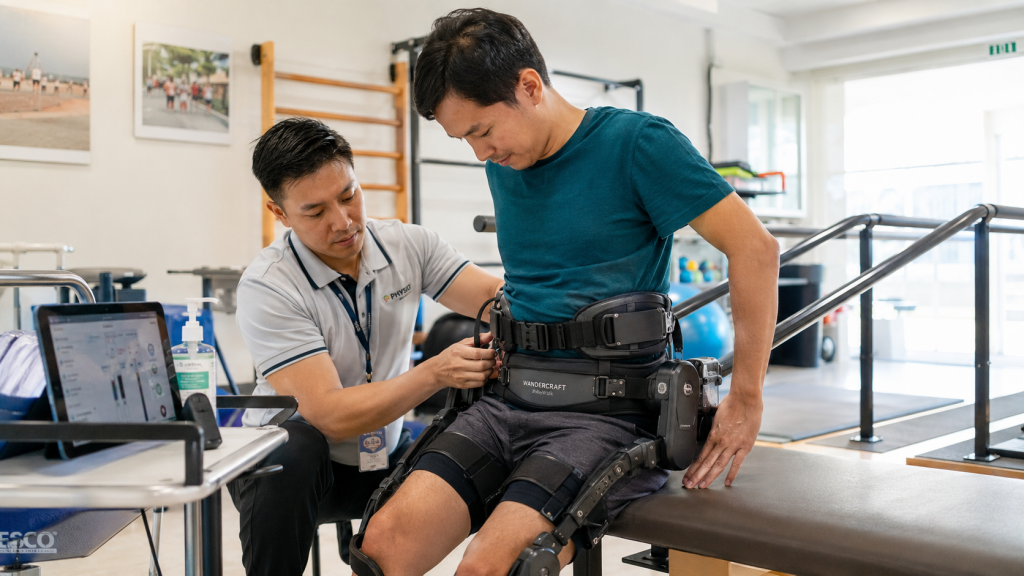
For years, wearable robotics sat in the category of astonishing demonstrations. What is changing now is not the dream, but the practicality. Exoskeletons and soft wearable devices are slowly moving from spectacle toward use.
The language around disability technology often swings between two extremes. On one side, there is sentimentality: the miraculous machine, the emotional reveal, the promise that technology will “restore” a life. On the other, there is scepticism so deep that every advance is dismissed as a publicity stunt. Neither view is especially helpful.
The more interesting truth sits in the middle. Wearable robotics are not about to sweep away the daily realities of disability. But they are beginning, in a serious and measurable way, to become more useful, more targeted and more human-centred than they were even a few years ago.[1][2]
That matters because mobility support has long been caught between two unsatisfactory choices. Either a person is offered a device that is reliable but static, such as a wheelchair, cane or brace, or they are shown a futuristic machine that looks impressive in a laboratory and less convincing in everyday life. The gap between those two worlds has been wide. What seems to be happening now is that the gap is narrowing.
Researchers writing in Nature Communications last year described a broad shift in wearable mobility technology toward real-world use, including exoskeletons, soft robotic wearables and systems designed not simply to prove a concept, but to function in outdoor, everyday settings.[1] That is a subtle but important change. A device that helps someone in a controlled demonstration is one thing. A device that remains useful on uneven ground, in daily routines, with fatigue, weather, clutter and the unpredictability of ordinary life is something else altogether.
Recent studies suggest that progress is no longer theoretical. In 2026, another Nature Communications paper reported that a portable hip exoskeleton improved walking economy for stroke survivors, pointing to the possibility that lighter and more practical devices can do more than offer occasional support; they may meaningfully reduce the energy cost of movement.[2] Earlier work has also shown promise in real-world soft robotic wearables designed to make walking more efficient for older adults outdoors, not only in clinics.[3]
Meanwhile, the public imagination has been captured by devices that look closer to science fiction. Reuters reported in late 2024 on a South Korean team’s WalkON Suit F1, a wearable robot developed to help paraplegic users walk, climb stairs and navigate obstacles.[4] It is the kind of story that naturally attracts attention, and understandably so. But the real significance is not that the machine looks futuristic. It is that engineers are increasingly designing these systems around the user’s movement, environment and safety rather than around the machine alone.
Still, this is the point at which honesty matters. Breakthroughs in mobility technology are rarely as simple as news coverage makes them seem. A device may be effective and still be too expensive. It may work well in rehabilitation and still not suit long stretches of independent daily use. It may fit one condition well and be of little use to someone with a different body, different stamina, different priorities or different terrain to navigate. There is no universal answer here, and there probably never will be.
That should not be read as failure. It should be read as maturity. Disability technology grows up when it stops promising one grand solution and starts building many better ones.
In practice, the next stage of progress is likely to depend less on dazzling hardware than on ecosystem thinking. If wearable robotics are to move beyond headlines, they will need trained clinicians, funding pathways, insurance or subsidy support, repair networks, user training and designs that accommodate the fact that people live varied lives. A great device that cannot be maintained, adjusted or paid for is not yet a great disability solution.
There is also a larger cultural shift underway, and it may be just as important as the engineering. More developers now appear willing to accept that good assistive technology should not feel like a heroic exception to the body. It should feel like a practical extension of it. The best device is often not the most dramatic one. It is the one that reduces strain, preserves energy, supports confidence and quietly fits into a routine.
That is why exoskeletons and related wearables are worth watching now. Not because they have suddenly become magical, but because they are beginning to answer the right questions. Can they be lighter? Can they be safer? Can they work outside the clinic? Can they reduce effort, not just create motion? Can they respect the reality that independence is not always about standing upright, but about having more choices over how to move through a day?
These are the kinds of questions that tend to produce useful technology rather than symbolic technology.
There is reason for hope here, provided it remains disciplined. We are not looking at a future in which every person with a mobility disability trades in a wheelchair for a robotic suit. That is not how disability works, and it is not how good support works either. But we may be entering a period in which wearable mobility devices become more believable as one option among many: not a replacement for all other tools, but a meaningful expansion of what is possible for some people in some settings.
That is already a substantial development.
The real test over the next few years will not be whether engineers can produce another striking prototype. It will be whether these technologies can become more affordable, more customisable and more ordinary. The moment assistive robotics begin to feel less like a novelty and more like a serviceable part of life is the moment they will have truly arrived.
And for many disabled people, that quieter kind of progress may matter most of all.
Source notes
[1] Gao, S. et al., “Wearable technologies for assisted mobility in the real world,” Nature Communications (2025). https://www.nature.com/articles/s41467-025-67126-4
[2] Pruyn, K. et al., “Portable hip exoskeleton improves walking economy for stroke survivors,” Nature Communications (2026). https://www.nature.com/articles/s41467-026-69580-0
[3] Tricomi, E. et al., “Soft robotic shorts improve outdoor walking efficiency in older adults,” Nature Machine Intelligence (2024). https://www.nature.com/articles/s42256-024-00894-8
[4] Reuters, “South Korean team develops ‘Iron Man’ robot that helps paraplegics walk” (23 December 2024). https://www.reuters.com/technology/south-korean-team-develops-iron-man-robot-that-helps-paraplegics-walk-2024-12-23/