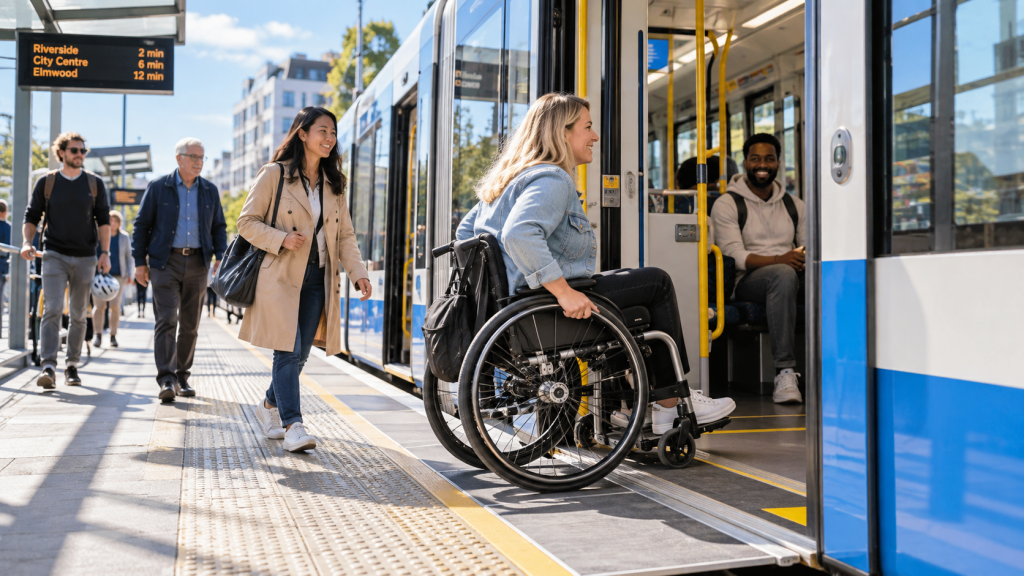
Original source: The Guardian
Making public transport accessible is normally presented as something society should pay for because it is fair.
A recent British analysis asks a different question: what if inaccessible transport is itself extraordinarily expensive?
The Institution of Mechanical Engineers has estimated that fully accessible public transport in the United Kingdom could potentially add around £176 billion a year to economic output. The calculation is based partly on the number of working-age disabled people whose participation in employment is restricted by transport barriers.
The same analysis estimates that upgrading Britain’s transport infrastructure would require substantial investment, but the broader argument is straightforward. When somebody cannot reliably reach a workplace, the economic cost does not belong only to that individual.
An employer loses access to labour. Government may lose tax revenue. The person has less income to spend. Retailers, restaurants and leisure businesses receive less custom.
Accessibility therefore has an economic dimension as well as a social one.
The figures are projections and should be treated as such. But the question they raise is worth asking everywhere.
When we calculate the cost of accessibility, are we also calculating the cost of leaving the barrier where it is?
Credit: The Guardian, Richard Partington.
Backlink: Original Guardian report.