Disability and sport are often discussed through the Paralympics. That makes sense. Elite athletes provide extraordinary demonstrations of what adaptive equipment, training and determination can achieve.
But most people are not elite athletes.
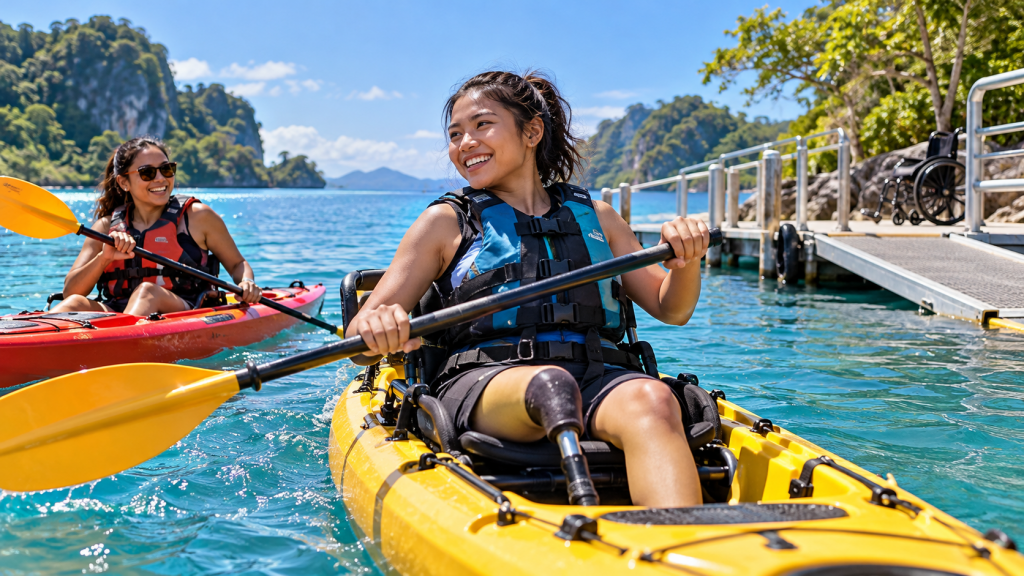
They are people who would simply like to ride a bicycle with their children, go kayaking with friends, play a game, exercise without feeling conspicuous, or discover what it feels like to move for pleasure rather than therapy.
That is why some of the most interesting developments in adaptive recreation are happening away from stadiums.
Researchers and engineers are beginning to treat recreation as something ordinary disabled people should be able to access rather than a specialist activity available mainly to athletes who can obtain expensive equipment.
A research project published in June 2026 by researchers affiliated with the University of Pittsburgh and other institutions set out to develop affordable, open-source adaptive sports and recreation equipment. The designs use predominantly 3D printing combined with readily available materials, allowing customised devices to be produced relatively cheaply. Completed designs already include swimming paddles, miniature-golf adaptations, billiards-stick handles, a cornhole-bag adaptation, a vehicle-shifter adaptor for an arm prosthesis and an attachment for pushing curling stones. Crucially, the files, materials lists and assembly instructions are being made publicly available. DOI
It is not the sort of innovation likely to be presented beside a humanoid robot at a technology conference.
It may be considerably more useful to somebody who simply wants to play.
Recreation is sometimes treated as a luxury within disability services. Funding understandably prioritises wheelchairs, communication devices, prosthetics and equipment required for education, personal care or employment.
But this creates a strange hierarchy.
We recognise that somebody needs technology in order to get to work, yet may treat the technology that lets the same person go cycling at the weekend as optional.
The distinction is not as clear as it appears. Physical recreation can support health, confidence, independence and social connection. It gives people reasons to leave the house that have nothing to do with appointments. It gives families things to do together and provides opportunities to develop skills chosen by the person rather than prescribed for them.
Research on adapted cycling published in April 2026 found that participants described benefits extending beyond physical fitness to independence, community participation, belonging and personal agency. The researchers also identified practical barriers including access to suitable equipment, whether a cycle properly matches the rider’s needs and whether the surrounding environment actually makes cycling possible. Frontiers
Adaptive cycling is particularly interesting because there is no single “disabled bicycle”. Handcycles allow riders to generate power using their arms. Recumbent trikes offer additional stability. Tandem bicycles can allow a sighted rider to pilot with somebody who is blind or has low vision. Other designs accommodate different balance, strength or positioning needs.
That variety is exactly what adaptive recreation requires.
The objective should not be to invent one standard machine for “the disabled”. It should be to provide enough options that more people can find something suited to how their body actually works.
Cost remains a persistent problem. Specialist equipment is produced in smaller numbers than mainstream sporting goods and customisation can add considerably to the price. This is what makes open-source design and lower-cost fabrication particularly interesting.
Nobody should casually 3D-print critical structural components of a handcycle without appropriate testing. Safety matters. But 3D printing is well suited to many smaller adaptations: grips, mounts, interfaces, game pieces and customised components that can turn an otherwise unusable activity into something somebody can participate in.
The technology becomes especially powerful when the design files themselves can travel. A useful adaptation developed in Pittsburgh does not necessarily need to be reinvented from scratch by somebody in another country. It can be downloaded, modified and tested locally.
That is a different model of innovation.
Instead of a company deciding what everybody needs and manufacturing one solution, disabled users can identify a problem, designers and engineers can respond, and others can improve the solution later.
There is also an important difference between adaptive recreation and rehabilitation. They may overlap, but they are not the same thing.
A person may become stronger from cycling. That does not mean the ride needs to be described as therapy.
Sometimes the point is to get outside.
Sometimes the point is speed.
Sometimes it is coffee at the end.
Sometimes it is doing something with friends that has absolutely nothing to do with disability.
That distinction is worth protecting. Disabled people spend enough time having ordinary activities interpreted through a medical lens.
Leisure is allowed to be leisure.
This is where Malaysia has considerable opportunity. Parks, beaches, recreational centres and cycling facilities could think more deliberately about adaptive equipment, accessible routes and partnerships with disability organisations. A facility does not need to own every possible piece of specialist equipment. Shared equipment libraries, rentals or partnerships with clubs could allow people to experiment without immediately committing to an expensive purchase.
Someone should be able to discover whether they enjoy handcycling before spending thousands on a handcycle.
The same principle applies to paddling, gym equipment, swimming and other recreational activities.
Access becomes much easier when people can try things.
There is also a wider cultural benefit. When disabled people appear in public spaces only as patients, workers or people receiving assistance, society develops an incomplete picture of disability. Seeing somebody race past on a handcycle, struggle cheerfully through a fitness class, play miniature golf using an adapted grip or spend an afternoon kayaking complicates that picture in a useful way.
The person is not proving anything.
They are simply having a life.
That is perhaps the most hopeful part of this emerging approach to adaptive recreation. The ambition is becoming less extraordinary.
The goal is not for every disabled person to become an athlete. It is for somebody who wants to ride, swim, paddle, play or exercise to have a realistic way to begin.
For years, assistive technology has understandably concentrated on helping people accomplish the tasks life demands.
The next stage should also make it easier to do some of the things that make life enjoyable.
Sources
Sorraghan et al., “Riding toward inclusion: the journey of adapted cycling,” Frontiers in Sports and Active Living, April 2026. Read the adapted-cycling research
Duvall et al., “Development of easy-to-make adaptive sports and recreation technology,” Journal of Rehabilitation and Assistive Technologies Engineering, June 2026. Read the adaptive-recreation research