Editorial note: These are MIND-written news summaries based on reporting by other publications. They should be published with the originating news organisation clearly credited and a backlink to the original report. They are not reproductions of the source articles.
Original source: Associated Press
A new film about one of the most influential figures in the disability rights movement is attempting something more ambitious than telling her story.
It is also testing whether a major film production can work differently behind the camera.
Being Heumann, directed by Siân Heder and starring Ruth Madeley as disability rights pioneer Judy Heumann, premiered as the opening-night film of the 2026 Toronto International Film Festival. The film follows the historic occupation of San Francisco’s federal building by more than 100 disability-rights protesters as they fought to force implementation of Section 504 of the Rehabilitation Act. AP News
Heder previously directed CODA, which won the Academy Award for Best Picture and featured several prominent Deaf performers. In speaking to Associated Press about the new film, she said she had seen Hollywood’s enthusiasm for disability inclusion recede once CODA was completed. With Being Heumann, she wanted to go further.
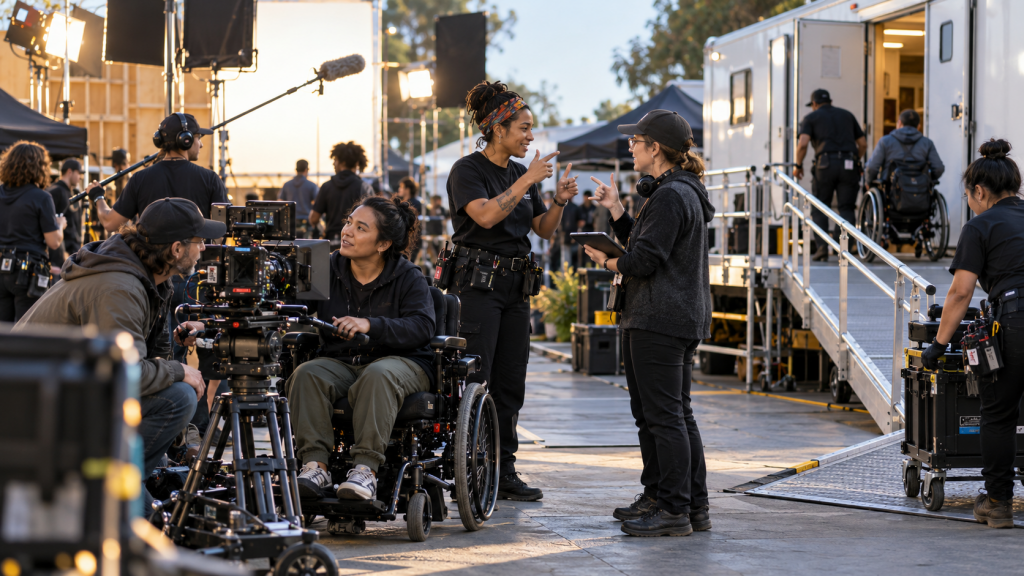
The production features a largely disabled cast, with Madeley joined by performers with a range of disabilities. That created a practical challenge: many conventional film sets remain surprisingly inaccessible.
Rather than treating this as a reason to reduce disabled casting, the production changed the environment. Heder told AP that the team built accessible trailers, constructed what became known as a “ramp village” and created a dedicated accessibility team. She described the process as, in effect, reinventing parts of filmmaking while making the film. AP News
That may be the most interesting part of the story.
Representation on screen receives considerable attention, and rightly so. Who appears in stories influences how society understands itself.
But representation means less if the industry producing those stories remains inaccessible to the performers, writers, technicians and other professionals whose lives are supposedly being represented.
The production therefore offers a useful test case. Accessibility can be treated as an obstacle to filmmaking, or it can be treated as a production problem to be solved like lighting, sound, scheduling or location management.
The second approach creates considerably more possibilities.
The film will receive a theatrical release on 6 November before arriving on Apple streaming services on 13 November. AP News
Its commercial and critical reception is still to come.
But one part of its legacy may already have been established.
The production has demonstrated that a major film can employ a predominantly disabled cast not by asking performers to somehow fit themselves into inaccessible filmmaking practices, but by changing the practices.
That is a lesson with relevance far beyond Hollywood.
Sometimes inclusion does not require lowering the standard.
It requires redesigning the workplace.
Credit: Jake Coyle, Associated Press, reporting from the Toronto International Film Festival, September 2026. AP News
Original article: Read the original Associated Press report