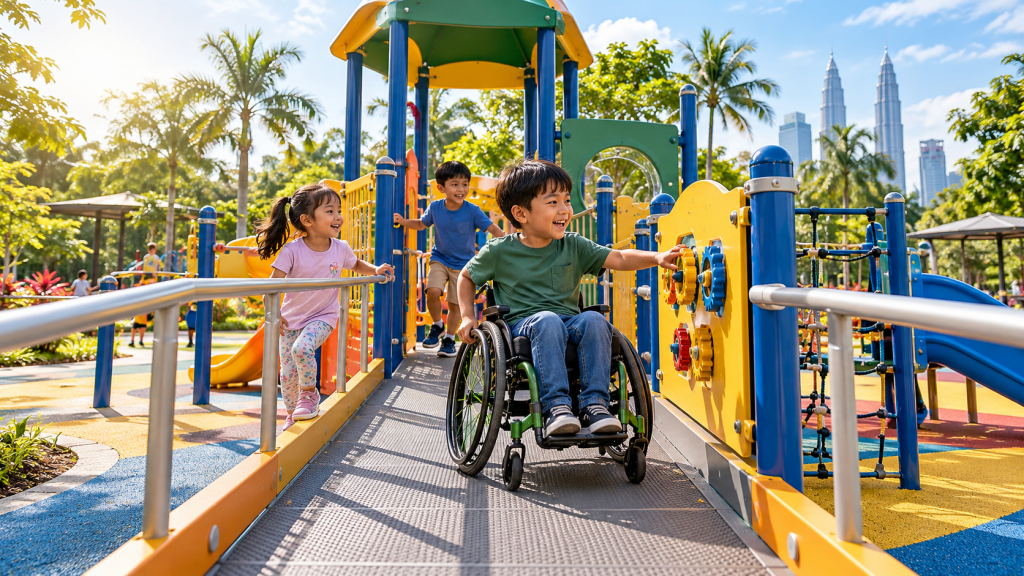
A playground tells children something long before anybody explains it to them. It tells them whether the place was built with them in mind.
For a child who can run across soft flooring, climb a ladder and swing independently, a playground usually delivers a simple message: go. For a child using a wheelchair, a child who cannot balance easily, or a child with visual, hearing or sensory differences, the message has too often been more complicated. You can come, but perhaps not there. You can watch, but perhaps not join in.
That is slowly beginning to change, including here in Malaysia.
This year, Taman Wawasan in Puchong underwent a RM1 million upgrade that included a new inclusive playground designed around Universal Design principles. The play area includes a ramp-access system wide enough for wheelchairs and strollers, allowing children using mobility devices to reach elevated play stations rather than being confined to what happens at ground level. The Star
The significance may seem modest compared with a medical breakthrough or a major infrastructure project. It is not.
Play occupies a strange position in public thinking. Adults understand instinctively that education matters, healthcare matters and nutrition matters. Play can be treated as something that happens once the important things are done.
For children, play is one of the important things.
It is where physical confidence develops and where negotiation begins. Children learn how to wait, share, compete, invent, take small risks and recover when something goes wrong. It is also one of the first places where friendships begin to form without adults arranging every interaction.
When a child cannot participate, they are not simply missing the slide. They may be missing the conversation happening around it.
UNICEF Malaysia has been making this argument for several years. Its inclusive-playground work emphasises play as an important part of children’s development and has produced an open-source guidance toolkit intended to help property developers and local authorities create disability-inclusive spaces. Malaysia’s inaugural inclusive playground at City of Elmina in Shah Alam was developed with Sime Darby Property using Universal Design principles and consultation involving children with and without disabilities, their families and disability practitioners. UNICEF
That last detail deserves attention.
Children were involved in designing a children’s space.
It sounds obvious, yet one of the easiest ways to produce poor accessibility is to guess what another person needs from a distance. An adult designer may think a ramp makes a playground inclusive. A child may immediately notice that the ramp merely reaches a platform from which every interesting activity still requires climbing.
Accessibility improves when the people expected to use something are involved in deciding how it should work.
The conversation also needs to extend beyond mobility. Tactile features, strong visual contrast, predictable layouts and sensory cues can help children with visual or hearing differences navigate spaces with greater confidence. Sensory experience matters too. A playground can be joyful chaos to one child and overwhelming noise to another. Some children with autism or other sensory differences may benefit from quieter areas where they can step away without leaving the playground altogether.
That does not mean every playground needs to become quiet or clinically controlled. It means good playgrounds can offer different types of experience within the same space.
Malaysia is also seeing this idea extend beyond outdoor parks. In August, We Rock the Spectrum Kid’s Gym opened in Taman Desa, Kuala Lumpur, offering what its operators describe as a sensory-safe indoor environment where children with and without disabilities can play alongside siblings and friends. The centre includes 12 pieces of therapeutic equipment intended to support movement, sensory development and social interaction. BERNAMA
None of this means the job is finished.
Inclusive playgrounds still make news partly because they are not yet ordinary. Maintenance is another challenge. An accessible swing that breaks and remains unusable for months is no longer accessible. Neither is a ramp blocked by furniture or a pathway that becomes difficult to navigate because surfaces have deteriorated.
Location matters too. If the only inclusive playground is an hour away, families without easy transport still face a practical barrier.
The larger ambition therefore has to go beyond several showcase parks. Accessibility should gradually become part of how ordinary neighbourhood play areas are designed.
There is good news inside that ambition. Inclusive playgrounds do not require children with disabilities to play in a separate corner. That is exactly what they are intended to avoid. The purpose is to create places where siblings play together, where disabled and non-disabled children meet without an organised programme, and where difference becomes part of normal childhood rather than something encountered during an awareness campaign.
There may even be something adults can learn from this.
Children are often remarkably quick to accommodate difference when adults do not make it strange. A child may notice a wheelchair, ask a direct question, receive an answer and then move rapidly on to the considerably more urgent matter of whose turn it is on the swing.
Shared play makes those encounters ordinary.
A playground therefore becomes more than a collection of equipment. It can become one of the earliest places where inclusion stops being theoretical.
There is no reason to pretend that a better slide will erase every barrier faced by a disabled child. It will not. Childhood, however, is made from thousands of small experiences, and being able to join rather than watch is one of the experiences worth getting right.
Perhaps the best inclusive playground will eventually be the one children stop describing as inclusive.
It will simply be the playground.
And everyone will know that they are allowed to play.
Sources
The Star, “Taman Wawasan gets RM1mil green overhaul,” 29 May 2026. Read The Star report
UNICEF Malaysia, Inclusive Playgrounds. UNICEF Malaysia — Inclusive Playgrounds
UNICEF Malaysia, Inclusive Playground Guidance Toolkit. UNICEF inclusive-playground toolkit
Bernama, “WRTS Kid’s Gym Taman Desa Opens Doors To Children Of All Abilities,” 23 August 2026. Read the Bernama report