Original source: Associated Press
A theatre built more than two thousand years ago might seem an unlikely place to look for the future of accessibility. Yet the Ancient Theatre of Epidaurus in Greece has provided a striking example of what can happen when heritage and accessibility are treated as problems to solve rather than automatic contradictions.
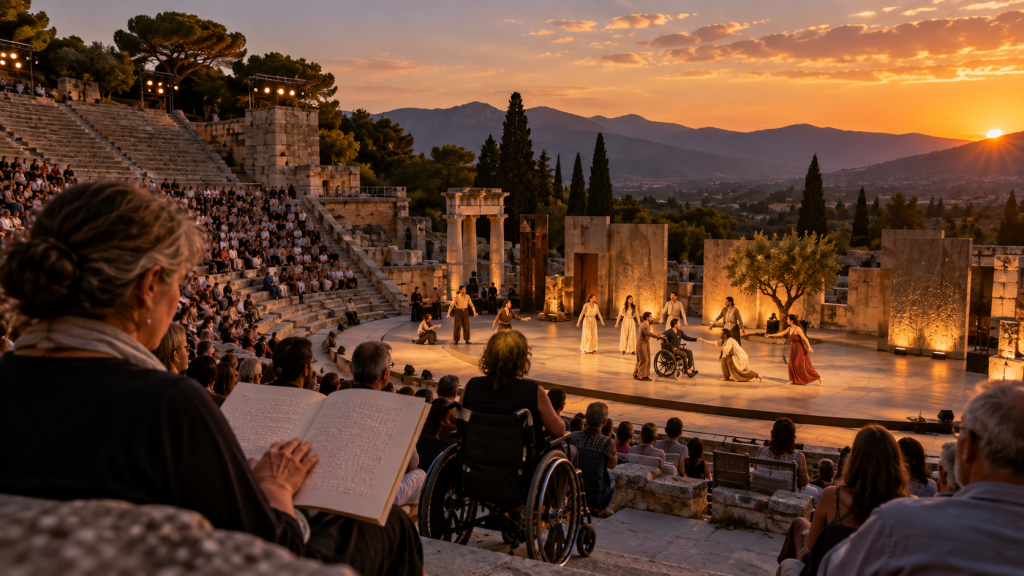
The National Theatre of Greece staged Euripides’ The Trojan Women at the 2,300-year-old venue in what Associated Press reported was the first fully accessible production in the theatre’s history.
The cast included disabled and non-disabled performers, while accessibility extended to the audience as well. Braille programmes, tactile models and live audio description were available for blind and visually impaired visitors, and Deaf audience members could follow overhead titles.
Making a site of this age accessible is obviously not the same as adapting a modern theatre. Historic structures come with restrictions, preservation requirements and physical limitations that cannot simply be rebuilt away.
That is exactly what makes the project interesting.
Rather than claiming every barrier could disappear, the organisers worked within the limitations of the space and addressed what could realistically be changed. It is a useful reminder that accessibility conversations do not need to be trapped between perfection and doing nothing.
Historic architecture can be difficult.
Difficult does not always have to mean impossible.
Credit: Associated Press, Petros Giannakouris and Derek Gatopoulos.
Backlink: Original Associated Press report.