For a long time, accessible design was treated as something specialised. It belonged to hospitals, rehabilitation centres, disability NGOs and the occasional public building that had been forced, usually after some delay, to do the right thing. In everyday life, mainstream design often continued as though disability were a niche concern rather than a normal part of the human condition.
That old division is becoming harder to defend. The World Health Organization estimates that around 1.3 billion people, roughly one in six globally, experience significant disability.[1] Add ageing populations, temporary injuries, chronic illness and the ordinary unpredictability of life, and the case for better design starts to look less like a concession and more like common sense.
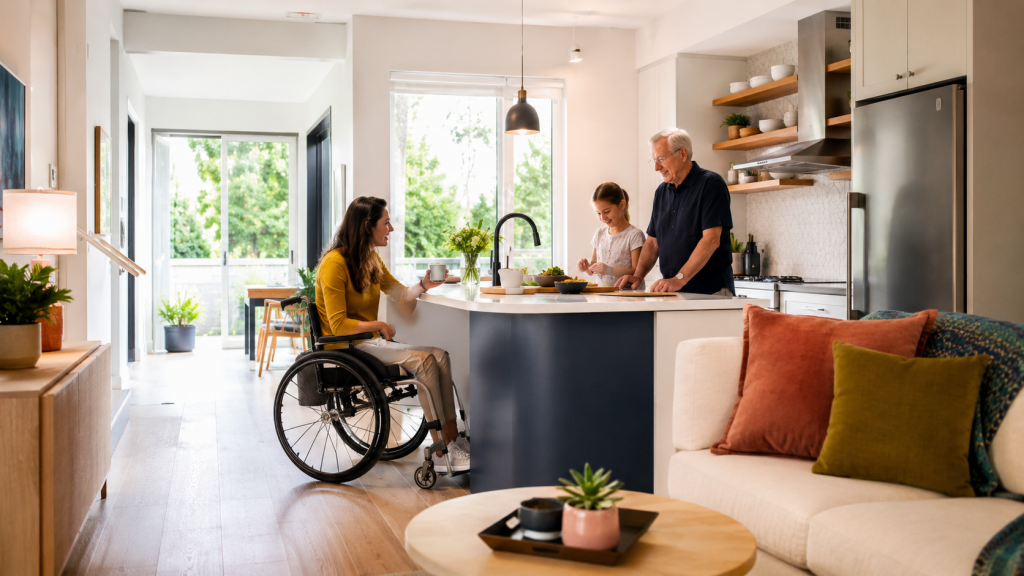
The challenge is that everyday spaces and products still carry the assumptions of another era. Housing remains one of the clearest examples. The National League of Cities noted in 2025 that while 26 percent of people in the United States have a disability, less than 6 percent of housing is accessible.[2] That gap is not just a statistic. It translates into daily negotiation: bathrooms that cannot be used safely, kitchens laid out as if everyone reaches and bends in the same way, entry points that turn a home into an obstacle course, and rental markets that treat accessible features as a rarity rather than good planning.
The more thoughtful conversation today is not only about compliance. It is about design quality. A World Bank paper on universal accessibility in urban infrastructure makes an unusually clear point: barriers are not inevitable; they are the product of design choices.[3] That sounds obvious, but it carries force. It means exclusion is not some natural fact of the built world. It is the result of what was prioritised and what was ignored.
Once you look at design through that lens, the disability story broadens quickly. It is not just about ramps and handrails, though those still matter. It is about wayfinding, lighting, surfaces, signage, acoustic comfort, sensory overload, reach ranges, seating, storage, changing rooms and counters. It is about whether a supermarket, a cafe, a bedroom or a train station is organised for the variety of human bodies and minds that actually exist.
That is why some of the most interesting progress is happening outside traditional disability spaces. Fashion is a good example. For years, adaptive clothing was spoken about in worthy tones but offered in narrow, often unattractive ways. Either the clothes solved a functional problem while ignoring style, or they were marketed so timidly that they felt separate from fashion itself. The better work now understands that ease, dignity and taste belong together.
The 2025 white paper ‘Co-designing adaptive fashion with the Disabled community’ argues that the industry needs to move from basic compliance to active co-design, mapping the friction points disabled consumers face across the shopping and wearing experience.[4] That shift in thinking matters. It replaces the old instinct to design for disabled people from a distance with the more useful discipline of designing with them. It also treats disabled consumers as customers with preferences, identities and standards, rather than as grateful recipients of whatever turns up.
That change is slowly making its way into the high street. In early 2025, Primark launched a 49-piece adaptive clothing range developed with disabled fashion designer Victoria Jenkins, including magnetic zips, hidden access points for medical equipment and cuts designed with wheelchair users in mind.[5] It would be naive to pretend this solves the broader problem. Choice is still limited, sizing can be inconsistent, and many brands remain far behind. But the significance lies in where the conversation is moving. Accessible design is beginning to show up in ordinary retail rather than only in specialist corners.
There is a wider lesson here. Good accessible design rarely helps only one group. A step-free entrance helps wheelchair users, parents with strollers, delivery workers and older people. Clear signage helps people with visual impairments, visitors in a hurry and anyone navigating an unfamiliar place. Clothing that is easier to fasten helps people with limited dexterity, people recovering from surgery and those who simply prefer less fuss. The point is not to blur disability away. It is to recognise that better design tends to travel well.
This is where hope enters the picture, though it needs to be honest hope. The everyday world is not suddenly becoming accessible. Too many products are still designed around an able-bodied default. Too many homes remain impractical. Too many retail environments still confuse brightness for welcome and clutter for experience. But there are visible signs of a shift. Co-design is no longer an obscure concept. Universal design is appearing more often in conversations about housing and city planning. Adaptive products are becoming less apologetic and more confident. Businesses are beginning, however unevenly, to notice that inclusion is not bad for beauty, brand or business.
The next step is to make those gains less dependent on isolated good actors. Accessible design should not rely on the handful of designers, architects or retailers who happen to care more than others. It needs to be built into briefs, procurement, education and product testing. It needs disabled people in the room early, not invited in later to comment on what has already been decided. And it needs organisations to stop treating accessibility as a line item and start seeing it as a mark of seriousness.
Perhaps that is the most hopeful part of where things stand. Accessible design is becoming harder to dismiss as niche. It is increasingly understood as part of what makes a product usable, a home liveable and a public space civilised. That does not mean the work is done. It means the argument is getting stronger.
And once that happens, everyday life itself becomes the place where change is felt: in getting dressed, entering a shop, cooking dinner, visiting a friend, finding the toilet, reading a sign, catching a train or simply moving through a room without having to negotiate with it first. That is where design proves what it really believes about inclusion.
Sources cited
[1] World Health Organization, ‘Disability’ overview. https://www.who.int/health-topics/disability
[2] National League of Cities, ‘Disability-Forward Design Across Multiple Cities,’ 27 January 2025. https://www.nlc.org/article/2025/01/27/disability-forward-design-across-multiple-cities/
[3] World Bank and partners, ‘Mainstreaming Universal Accessibility in urban infrastructure projects,’ 2024. https://documents1.worldbank.org/curated/en/099050124115516810/pdf/P174991-e845bd3a-8893-4bb6-91ae-5f1b19bfb4ff.pdf
[4] Tilting the Lens, ‘Co-designing adaptive fashion with the Disabled community,’ white paper, 2025. https://adee.es/wp-content/uploads/2025/12/Tilting-the-Lens_Adaptive-Fashion-White-Paper_2025.pdf
[5] The Guardian, ‘Primark launches clothing range designed for people with disabilities,’ 22 January 2025. https://www.theguardian.com/fashion/2025/jan/22/primark-launches-clothing-range-designed-for-people-with-disabilities