Editorial note: These are MIND-written news summaries based on reporting by other publications. They should be published with the originating news organisation clearly credited and a backlink to the original report. They are not reproductions of the source articles.
Original source: The Guardian
Accessibility is usually discussed in terms of modifying places that already exist.
Add captions. Improve the lighting. Change the entrance. Install an induction loop. Make room for an interpreter.
A project taking shape in London is asking a different question: what would happen if the space itself were designed around Deaf people from the beginning?
Urban planner Amanprit Arnold has launched the DeafCity Hub campaign, which aims to create what The Guardianreports would be the UK’s first permanent Deaf-led cultural and co-working centre designed specifically around the Deaf community. The project has secured a temporary one-year space through a partnership involving Westminster city council and the Oxford Street Development Corporation while it builds the case for a permanent home. The Guardian
What makes the project particularly interesting is the architecture.
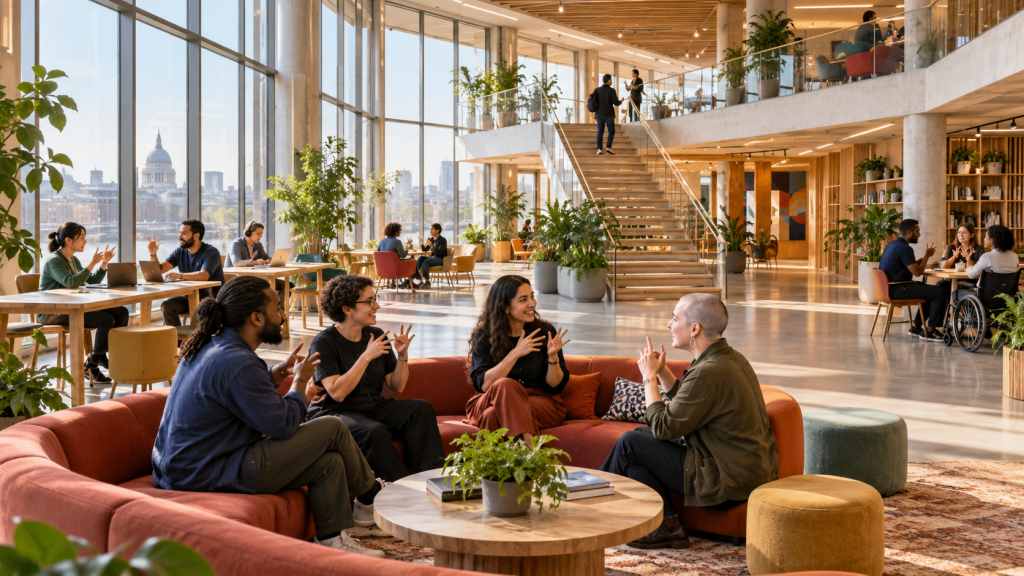
Arnold wants the permanent centre to follow DeafSpace principles: wide corridors and staircases that allow people to walk side-by-side while signing, circular seating arrangements where people can clearly see one another, natural light and softer colours to reduce visual fatigue, and strategic use of glazing and sightlines so people can remain aware of what is happening around them. The Guardian
These are not simply modifications added to make a conventional building usable. They begin with the way sign language and visual communication actually work.
British Sign Language is spatial. Faces, hands, body movement and sightlines matter. A narrow corridor designed for people communicating through speech may function perfectly well for hearing users while constantly interrupting a signed conversation.
This is why DeafSpace is a useful design idea even beyond this particular London project. It demonstrates that accessibility can mean more than making an existing environment technically compliant. Sometimes it means asking whether the assumptions underneath the original design were right in the first place.
The temporary DeafCity Hub will now have to demonstrate demand and attract the investment required for a permanent centre. Arnold has described a wider ambition in which London could eventually provide a model for similar spaces elsewhere. The Guardian
Whether that vision reaches its full scale remains to be seen.
But the premise is valuable already.
There is a noticeable difference between being permitted into a place and entering a place that seems to understand how you live.
The most interesting accessible buildings of the future may be the ones that do not look as though accessibility was added at all.
Because it was there from the first drawing.
Credit: Alice Fisher, The Guardian, 21 September 2026. The Guardian
Original article: Read the original Guardian feature