Editorial note: These are MIND-written news summaries based on reporting by other publications. They should be published with the originating news organisation clearly credited and a backlink to the original report. They are not reproductions of the source articles.
Original source: Reuters
A design created from personal experience has won the United Kingdom’s 2026 James Dyson Award, offering a glimpse of how artificial intelligence can sometimes solve a very practical problem without trying to reinvent everyday life.
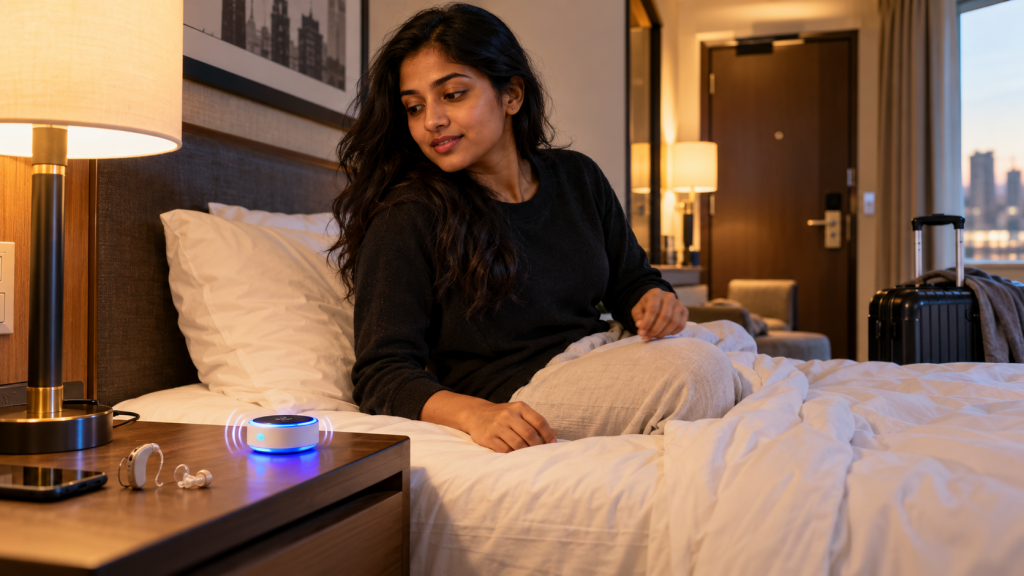
SIVO.GO is a portable sensory safety system designed by Loughborough University graduate Gargi Agrawalla, who is profoundly Deaf and uses cochlear implants. The problem she set out to solve is a simple but important one: when Deaf and hard-of-hearing people remove hearing devices to sleep, shower or swim, they can also lose awareness of alarms, doorbells and other environmental sounds.
That can become particularly difficult when travelling.
Hotels and temporary accommodation are not always equipped with the visual or vibrating alert systems someone may use at home. Existing solutions can also mean travelling with several separate pieces of equipment for alarms, doors and waking.
Agrawalla told Reuters that her own experience of relying on her family while travelling helped inspire the project. As she began living independently at university, she wanted a system that would reduce that dependence. Reuters Connect
SIVO.GO combines several functions in one portable system. Its AI model listens locally for consistent emergency sounds such as fire alarms and doorbells, while a separate vibration sensor detects door activity. The user can then be alerted through vibration, bright light and screen symbols depending on whether the device is being used in a bedroom, general living space or bathroom. Importantly, the sound-recognition model operates locally rather than requiring Wi-Fi or cloud processing. James Dyson Award
The project is still a prototype rather than a finished commercial product, so it would be premature to write about it as though it were already changing travel for millions of people. Agrawalla’s next steps include improving reliability and manufacturability, further user trials and pursuing funding, certification and commercial partners. James Dyson Award
What makes the project interesting is its restraint. The technology is sophisticated, but the problem it addresses is ordinary: sleeping safely in a hotel, knowing someone is at the door or recognising an emergency alarm while taking a shower.
That is often where genuinely useful disability innovation begins.
Not with the question, “What extraordinary thing can AI do?”
But with a much more practical one.
“What problem is making somebody unnecessarily dependent, and can we fix it?”
Credit: Reuters, reporting from London, September 2026. Reuters Connect
Original report: View the Reuters report