AUGUST 2026
Disability conversations often focus on work, healthcare, transport and law. All of that matters. But so does play. So does leisure. So does the right to join friends, unwind, compete, explore and simply enjoy the culture of the day without unnecessary barriers.
There is a habit, especially in serious policy circles, of treating leisure as somehow optional to human wellbeing. Work is essential. Education is essential. Healthcare is essential. Play, by contrast, is often treated as a luxury that can wait until the important matters are settled.
Yet anyone who has spent time thinking honestly about disability knows that this hierarchy is too crude. A full life is not made only of services and survival. It is also made of enjoyment, friendship, challenge, boredom relief, community and the simple dignity of being able to take part in ordinary culture.
That is why gaming accessibility deserves more attention than it often gets. Video games are no longer a subculture tucked away in bedrooms. They are a mainstream form of entertainment, storytelling and social connection. According to the Entertainment Software Association’s 2025 data, 21% of adult players in the United States report having a disability.[1] That figure alone should have ended the idea that accessibility in games is a marginal issue.
The industry has, to its credit, begun to respond. In March 2025, the ESA launched the Accessible Games Initiative, a tagging system designed to give players clearer information about accessibility features in games.[2] That may sound modest, but it addresses one of the most frustrating parts of the experience for disabled players: the uncertainty before purchase. If someone does not know whether a game supports subtitles, remappable controls, narrated menus or save-anywhere functionality, they are being asked to buy blind.
That is where better standards begin to matter. Microsoft has already integrated these accessibility tags into the Xbox ecosystem, making it easier for players to identify features such as adjustable font size, button remapping and other gameplay, visual, auditory and input supports.[3] Alongside this, the long-running Game Accessibility Guidelines project continues to offer a practical industry reference for reducing unnecessary barriers in design.[4]
None of this should be misunderstood as a sign that the problem is solved. Accessibility in games remains uneven. Some studios still treat it as a late-stage patch or a public-relations talking point. Feature disclosure can be inconsistent. Menus can still be unreadable. Tutorials can move too quickly. Colour contrast can remain poor. Subtitles may exist but be too small. Control schemes can assume dexterity patterns that many players simply do not have. Online social features can introduce fresh communication barriers of their own.
But it would be equally wrong to miss the progress that has occurred. A decade ago, accessibility in games often depended on a handful of unusually committed studios and vocal players. Today it is better understood as part of product quality. If a game cannot be comfortably used by a meaningful portion of its audience, that is increasingly seen not as a niche issue, but as a design limitation.
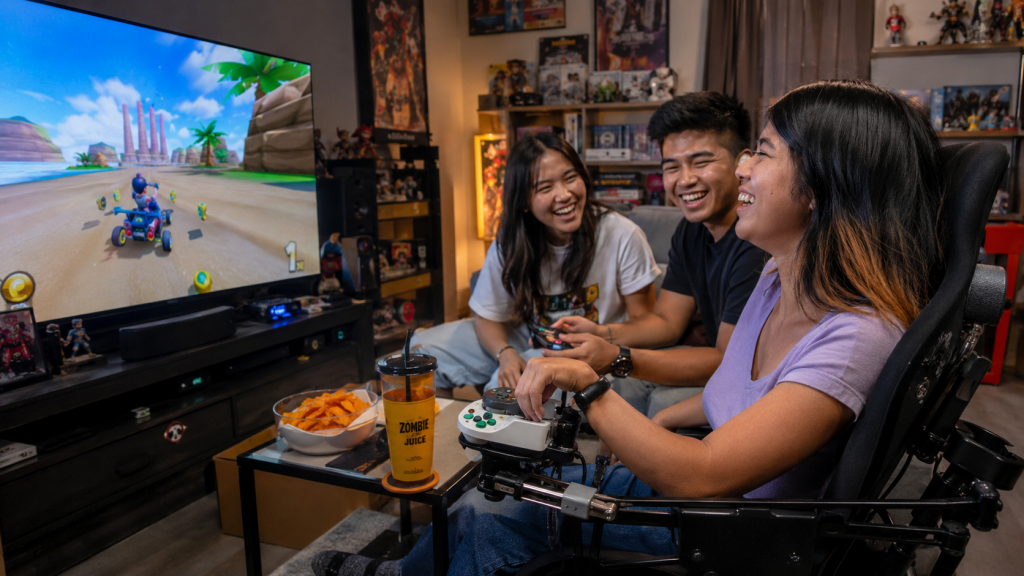
The deeper value of gaming accessibility lies beyond technical settings alone. Games are social objects. They give friends something to do together. They create shared references and conversations. They offer worlds in which competence can be built and autonomy can be felt. For some disabled players, especially those whose mobility, pain or fatigue limit other forms of leisure, games can provide a vital form of participation that is not second-best but fully real.
That is why the conversation should move beyond “Can disabled people play?” to a more mature question: “How well are we designing play for human variety?”
Once asked that way, the benefits become easier to see. Better subtitle systems help more than Deaf and hard-of-hearing players. Better difficulty options help more than one diagnostic category. Save-anywhere systems help people whose energy or pain fluctuates. Clearer interfaces help new players, tired players and players on smaller screens. Accessibility often improves the experience not by narrowing the audience, but by expanding who can enjoy the work without needless frustration.
In that sense, gaming is a useful lesson for the wider culture. Accessibility is not always about creating a separate route for a separate group. Very often it is about making the main route more flexible, readable and humane.
There is a hopeful quality to the moment. Discovery tools are improving. Industry language is improving. Developers have better guidelines than before. Players are more vocal and more organised. And the rise of accessibility tagging suggests that the market is beginning to understand something simple: if people cannot tell whether they can play your game, then you have already lost a portion of your audience before they even press start.
The next step should be to make accessibility information standard, early and transparent. It should appear in storefronts, previews and demos, not just in post-launch patch notes. Studios should think about accessibility as part of creative ambition, not as a constraint upon it. A more accessible game is not necessarily a lesser challenge. Often it is simply a better-designed one.
For disability communities, this shift matters because leisure is part of self-determination. The ability to choose one’s fun, one’s challenges and one’s social world is not trivial. It is one of the things that makes life feel like one’s own.
That is why gaming accessibility deserves to be taken seriously. Not because games are more important than housing or employment, but because a good society does not divide life so crudely into what is necessary and what is worth living for.
It understands that both matter.
And when accessibility reaches the sphere of play, it tells us something encouraging: inclusion is starting to move beyond the bare minimum and into the texture of everyday life.
Source notes
[1] Entertainment Software Association, “2025 Essential Facts About the U.S. Video Game Industry.” https://www.theesa.com/resources/essential-facts-about-the-us-video-game-industry/2025-data/
[2] Entertainment Software Association, “Entertainment Software Association Introduces the Accessible Games Initiative” (20 March 2025). https://www.theesa.com/entertainment-software-association-introduces-the-accessible-games-initiative-to-provide-players-with-information-about-accessibility-features-in-video-games/
[3] Xbox, “Accessibility in games / Accessible Gaming.” https://www.xbox.com/en-SG/community/for-everyone/accessibility
[4] Game Accessibility Guidelines, official reference site. https://gameaccessibilityguidelines.com/