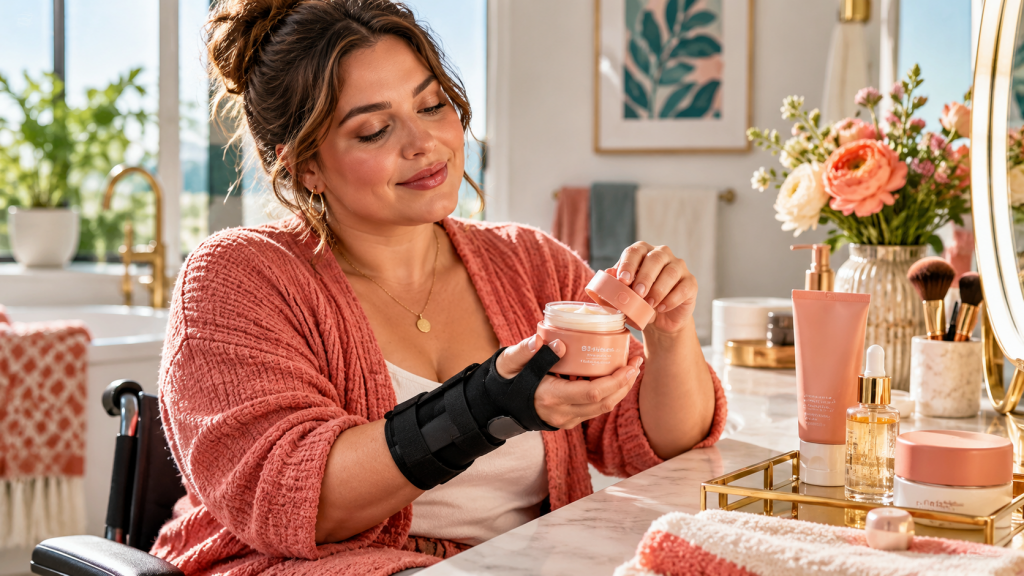
There is a particular kind of bad design that most people never notice. A mascara tube that demands a firm grip to open. A small cap that becomes almost impossible to twist when your hands are painful. Two bottles that feel identical even though one contains shampoo and the other conditioner. A pump that requires more pressure than somebody with reduced hand strength can comfortably produce.
For most consumers, these are irritations. For somebody living with arthritis, tremors, muscular weakness, limited dexterity or visual impairment, they can determine whether a product can be used independently at all.
The beauty industry is beginning to pay considerably more attention to this. That matters because discussions about disability and independence understandably tend to concentrate on the larger things: transport, employment, housing, healthcare and mobility. But life is also made up of smaller routines. Getting dressed, shaving, applying moisturiser, doing your hair, putting on makeup or simply preparing yourself for the day are all part of personal independence.
One of the more interesting developments has come from brands beginning to research accessibility at the product-design stage rather than adding it later. Rare Beauty, for example, partnered with the Casa Colina Research Institute to examine what makes beauty products easier to use for people with upper-limb and dexterity limitations. The work has focused on grip, ease of opening and closing, applicator design and the amount of force required to use packaging.
The important part is not the brand itself. It is the shift in design philosophy. Instead of creating an obviously medical-looking line somewhere in a specialist corner, the idea is to improve mainstream products. That distinction matters because people do not stop caring about appearance because they develop arthritis, and they do not lose interest in fashion because their hands shake.
Accessible products should therefore not require consumers to choose between something that works and something they actually want to own. A closure can be easier to operate without looking clinical. A handle can be easier to grip without resembling hospital equipment. A pump can be activated with the side of the hand rather than the fingertip while still looking completely at home on a bathroom shelf.
There is also a useful lesson here for the wider consumer market. Accessible packaging often turns out to be simply better packaging. A bottle that can be opened with one hand helps somebody with limited arm movement, but it also helps a parent holding a child. A textured container helps somebody with reduced grip strength, but it is also easier to hold with wet hands. Tactile markings help a blind consumer distinguish between products and help anybody trying to tell shampoo from conditioner without their glasses.
This pattern appears again and again in design. Solve carefully for people experiencing the greatest friction and you often make the product easier for everybody else.
That does not mean every product can be made universally accessible. Packaging has technical demands. Some formulas need airtight seals, while others require pumps or applicators that protect the product. Not every existing item can be redesigned easily, and no single research programme can represent every disability or limitation.
That kind of honesty is useful because accessibility should not become another marketing word stretched until it means nothing. A company should not simply put a larger cap on a product, photograph somebody with a disability holding it and declare the problem solved.
True accessible design requires testing. Can the package be recognised? Can it be picked up? Can it be opened? Can the product be dispensed? Can it be applied accurately? Can it then be closed and stored? Those details determine whether a product is genuinely usable.
Affordability matters too. There is little achievement in designing an accessible product if accessibility becomes a luxury feature carrying a substantial price premium. The greatest progress will come when easier-to-use design becomes ordinary enough that consumers no longer have to search for it.
There are signs that the conversation is heading that way. Accessible beauty and adaptive fashion have gained more mainstream attention, and disability-led brands and creators are increasingly influencing product development rather than simply commenting on finished products from the outside.
This is a relatively small corner of the disability conversation, but perhaps that is precisely why it deserves attention. There is a tendency to discuss accessibility only when the stakes are enormous. Can somebody enter the building? Can somebody get a job? Can somebody receive healthcare? Those questions matter enormously. But independence is also the accumulation of ordinary things a person can do without needing another person to intervene.
Opening a bottle may not sound transformative. Neither does fastening a shirt, using a kettle or applying lipstick. Until you cannot do it yourself.
Sometimes the answer to accessibility is not a robot, a policy paper or a new building. Sometimes it is simply a better cap, a better handle or a better label.
Sources
Rare Beauty, Made Accessible Initiative and Casa Colina Research Institute study.
Ability Central, “Beauty Without Barriers: Accessibility, Representation, and Disability Pride,” 2026.
June Adaptive, “The Disability Beauty Revolution: How Accessible Design Is Changing Beauty and Fashion,” 2026.