JUNE 2026
Travel has always been sold as freedom. For many disabled travellers, it still requires too much advance planning, too much uncertainty and too many compromises. Yet this is also one of the areas where design thinking is finally starting to catch up.
There is a particular exhaustion that comes with travel when you are not only planning the destination, but planning for the system to fail you.
Will the assistance actually arrive? Will the staff know what they are doing? Will a wheelchair be returned intact? Will the aircraft have the equipment it is supposed to have? Will an app, a hotel, a transfer desk or a washroom become the part of the journey that quietly derails the whole day?
These are not dramatic questions. They are the ordinary calculations many disabled travellers make before a ticket is even booked.
That is why accessible travel has become such a revealing subject. It is not simply about tourism or comfort. It is about whether modern systems genuinely understand human variation, or whether they still assume a default body and then improvise around everyone else.
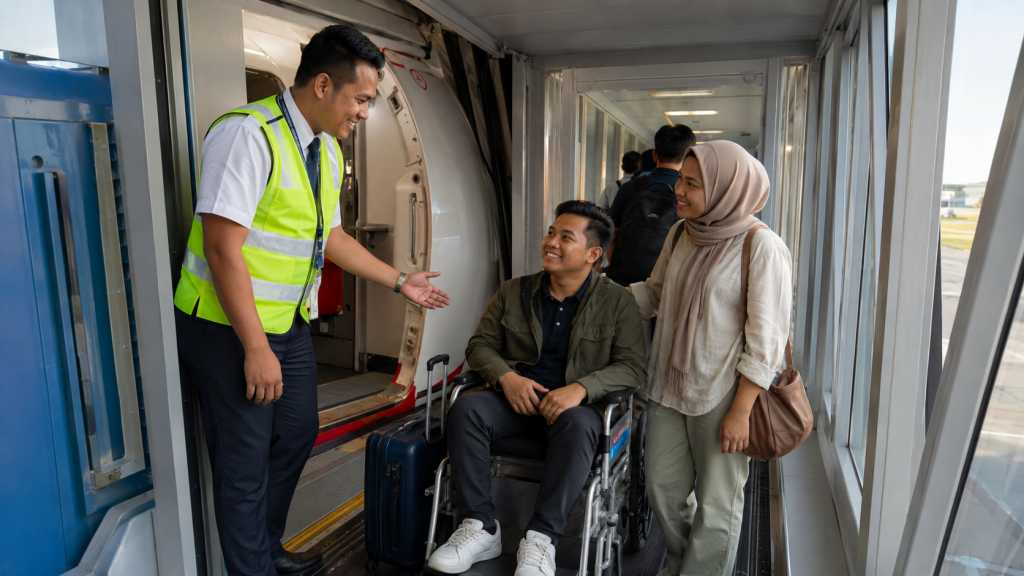
Aviation sits at the centre of this conversation because it concentrates so many of the issue’s contradictions. Flying is one of the most advanced consumer systems in the world, built on extraordinary attention to logistics, engineering and service design. And yet for disabled passengers, it can still be deeply inconsistent. One journey may go smoothly. The next may unravel through poor communication, improper transfers or the mishandling of essential mobility equipment.[1][2]
Regulators and industry groups are no longer pretending the issue is minor. In December 2024, the U.S. Department of Transportation issued a final rule strengthening protections for airline passengers with disabilities, especially wheelchair users. The rule tightened standards around assistance, mandated more rigorous training for airline staff and contractors, and specified what airlines must do when a wheelchair is damaged or delayed.[1] That was not a cosmetic move. It was an acknowledgement that dignity in travel depends on systems, not sentiment.
Industry guidance has also become more concrete. In a June 2026 fact sheet, the International Air Transport Association argued that all stakeholders should work together to eliminate barriers to travel, including better training, improved handling of mobility aids and clearer communications with passengers.[2] Again, the most striking part is not the language itself, but the shift in tone. Accessibility is increasingly being discussed not as a favour extended to a small group, but as a standard of service and design.
Perhaps the clearest sign of that shift came this April, when Airbus presented its Airspace U Suite concept, designed to allow some passengers with reduced mobility to remain in their own personal wheelchair during the flight.[3] Even as a concept, the idea carries symbolic weight. It recognises a basic truth that disabled travellers have long understood: the most stressful part of the journey is often not the flight, but the forced surrender of control over one’s own movement.
And yet it would be dishonest to suggest the problem is close to solved. Recent incidents continue to show how quickly policy and lived reality can diverge. Earlier this month, Paralympian Hannah Babalola described being denied access to an onboard wheelchair on a long-haul KLM flight, saying the experience left her choosing between humiliation and physical risk.[4] Her account struck a nerve precisely because it did not sound unusual enough.
This is where a more useful conversation needs to happen. Travel accessibility is often framed as a matter of special assistance, but that can be too narrow. Good travel design is not about creating a separate, awkward path for disabled people. It is about reducing points of unnecessary failure for everyone who moves through a system differently: older travellers, families with children, people recovering from injury, people with invisible disabilities, people whose stamina changes during the day, and people who simply need clearer information and fewer unpleasant surprises.
In other words, the future of accessible travel is unlikely to look like a separate category. It will look like better travel.
That future will depend on several things happening at once. Staff training needs to improve, not as a box-ticking exercise but as operational competence. Airlines and airports need more reliable handling protocols for wheelchairs and other assistive devices. Digital systems, from booking platforms to airport communications, need to be easier to navigate. Cabin interiors and washroom access need to keep evolving. Hotels, ride services and tourist destinations also need to stop assuming that accessibility begins and ends at the front door.
None of this is especially glamorous. But that is often how real progress works. The most meaningful changes are usually the ones that remove friction before it becomes crisis.
There is reason to think this shift is underway. The industry is under more scrutiny. Public expectations are rising. The design conversation is getting smarter. Accessibility is starting to be understood as part of customer experience, not apart from it.
That matters because travel does something valuable to the human spirit. It changes pace, perspective and confidence. It reconnects people with family, work, curiosity and pleasure. For disabled people, access to that wider world should not depend on luck, resilience or the willingness to absorb indignity.
It should depend on competence.
The encouraging thing is that competence is teachable. Better rules can be written. Better cabins can be designed. Better interfaces can be built. Better assumptions can replace old ones. A journey that feels simple to most travellers should not require elaborate contingency planning from others.
Accessible travel is still uneven. That is the truth. But it is no longer stuck in the language of charity alone. It is moving, slowly and unevenly, into the language of design, service and engineering. That is a healthier place for it to be.
And if that transition continues, disabled travellers may finally spend less time planning around barriers and more time planning around possibility.
Source notes
[1] U.S. Department of Transportation, “Secretary Buttigieg Announces Sweeping Protections for Airline Passengers with Disabilities” (16 December 2024). https://www.transportation.gov/briefing-room/secretary-buttigieg-announces-sweeping-protections-airline-passengers-disabilities
[2] International Air Transport Association, “Air Travel Accessibility Fact Sheet” (June 2026). https://www.iata.org/en/iata-repository/pressroom/fact-sheets/fact-sheet-accessibility/
[3] Airbus, “Airspace U Suite: redefining accessible air travel for everyone” (15 April 2026). https://www.airbus.com/en/newsroom/stories/2026-04-airspace-u-suite-redefining-accessible-air-travel-for-everyone
[4] The Guardian, “KLM apologises after Paralympian denied onboard wheelchair on 11-hour flight” (9 June 2026). https://www.theguardian.com/world/2026/jun/09/klm-apologises-after-paralympian-denied-onboard-wheelchair-on-11-hour-flight