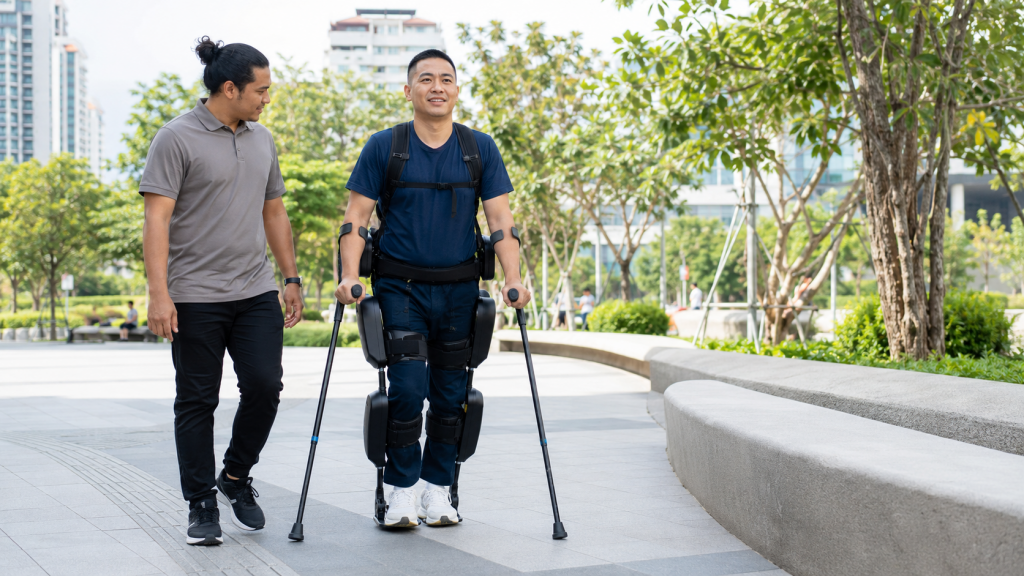
Not long ago, wearable robotics sat in the public imagination somewhere between the trade fair and the science fiction film. They were fascinating to watch, easy to admire, and difficult to picture in ordinary life. That picture is now beginning to change. The most interesting shift is not that exoskeletons and smart mobility devices are becoming more dramatic. It is that they are becoming more practical.
The need is large and growing. The World Health Organization estimates that 3.5 billion people will need assistive technology by 2050, yet in many countries most people who need it still do not have access.[1] That gap helps explain why this field matters. Mobility support is no longer just about inventing something impressive. It is about closing the distance between what is technically possible and what people can actually use.
A recent overview in Nature Communications captures where the field is heading. The emphasis is moving toward lightweight, user-adaptive devices designed for real-world use, including exoskeletons, prosthetics, smart wheelchairs and non-visual navigation systems.[2] That phrase, ‘real-world use’, is doing a lot of work. It marks a quiet but important correction. For years, too much disability technology was judged by the elegance of the prototype rather than the usefulness of the product. A machine could look revolutionary in a lab and still be far too heavy, costly, awkward or tiring for daily life.
Now the better work is asking harder questions. Can the device be put on without needing a small team around you? Does it help in the home, on pavements, on stairs and in public spaces, rather than just on polished floors? Can the user trust it when they are tired? Does it adapt to the person, or does the person have to adapt to the machine?
Those questions matter because mobility is about much more than movement. It is about energy, timing and dignity. A person may not want technology simply to walk a few more metres in a clinical setting. They may want to stand long enough to cook, to move around an office without planning every minute, to climb a short set of stairs without turning the day into a logistical problem, or to hold a conversation at eye level. Those are not glamorous ambitions, but they are often the ones that most clearly shape independence.
There are reasons to believe the technology is beginning to meet life on more realistic terms. Reuters reported in late 2024 on the WalkON Suit F1 developed by researchers at KAIST in South Korea. The wearable robot can approach a paraplegic user, lock onto the body, help the user stand, walk, climb stairs and manoeuvre obstacles.[3] It is still a prototype, and it would be a mistake to oversell where such systems stand today. But it is a sign of the direction of travel: less spectacle, more assistance that tries to work with the realities of daily life.
The more encouraging development may actually be the less cinematic one. In 2026, researchers writing in Nature Communications reported that a portable, lightweight hip exoskeleton reduced the metabolic cost of walking by 18 percent in stroke survivors with chronic hemiparesis.[4] That number matters because fatigue is one of the most underestimated barriers in disability support. A technology that makes walking measurably less exhausting is not simply adding movement. It is potentially returning time, confidence and endurance.
This is where the conversation becomes more mature. The point of assistive technology is not to chase a fantasy of making every disabled body look non-disabled. It is to reduce friction. Sometimes that will mean helping someone stand or walk. Sometimes it will mean making a wheelchair smarter, a navigation tool more responsive, or a support device easier to wear for longer periods. The breakthrough is not always in replacing an existing aid. It may lie in improving comfort, conserving effort, widening options or expanding the range of environments in which a person can move safely.
Still, realism matters. For all the progress, wearable robotics is not about to sweep away the basic barriers that shape disabled life. Cost remains a major obstacle. So does uneven access to rehabilitation, assessment and repair services. A device that looks transformative in one specialist centre may be irrelevant in a community with poor transport, limited insurance coverage or no local technician who can service it. There is also the simple fact that no single device suits every body or every impairment. Some users will benefit greatly. Others will find the trade-offs too steep.
That is why the future of this field will be decided as much by systems as by engineering. Better procurement matters. So do financing pathways, local maintenance networks, user training and honest clinical guidance. A smart device that cannot be funded, repaired or adjusted is not truly assistive. It is aspirational.
The best ideas now coming through the sector understand this. They are less obsessed with replacing the body and more interested in supporting function in ways that are specific, flexible and humane. They are being designed with greater attention to user feedback, terrain, fatigue and the routines of ordinary life. That may sound less heroic than the old rhetoric of miracle technology. In truth, it is more hopeful.
Hope in disability innovation is strongest when it becomes believable. Not when a machine briefly dazzles, but when it proves dependable. Not when it promises to erase every limitation, but when it quietly makes the day more manageable. That is what makes the rise of wearable robotics and smart mobility worth watching. The field appears to be moving, slowly but importantly, from demonstration to usefulness.
And if that movement continues, the real story will not be that machines have become more impressive. It will be that they have finally started becoming more human.
Sources cited
[1] World Health Organization, ‘Assistive technology’ fact sheet, updated 2 January 2024. https://www.who.int/news-room/fact-sheets/detail/assistive-technology
[2] S. Gao et al., ‘Wearable technologies for assisted mobility in the real world,’ Nature Communications, 2025. https://www.nature.com/articles/s41467-025-67126-4
[3] Reuters, ‘South Korean team develops “Iron Man” robot that helps paraplegics walk,’ 23 December 2024. https://www.reuters.com/technology/south-korean-team-develops-iron-man-robot-that-helps-paraplegics-walk-2024-12-23/
[4] K. Pruyn et al., ‘Portable hip exoskeleton improves walking economy for stroke survivors,’ Nature Communications, 2026. https://www.nature.com/articles/s41467-026-69580-0