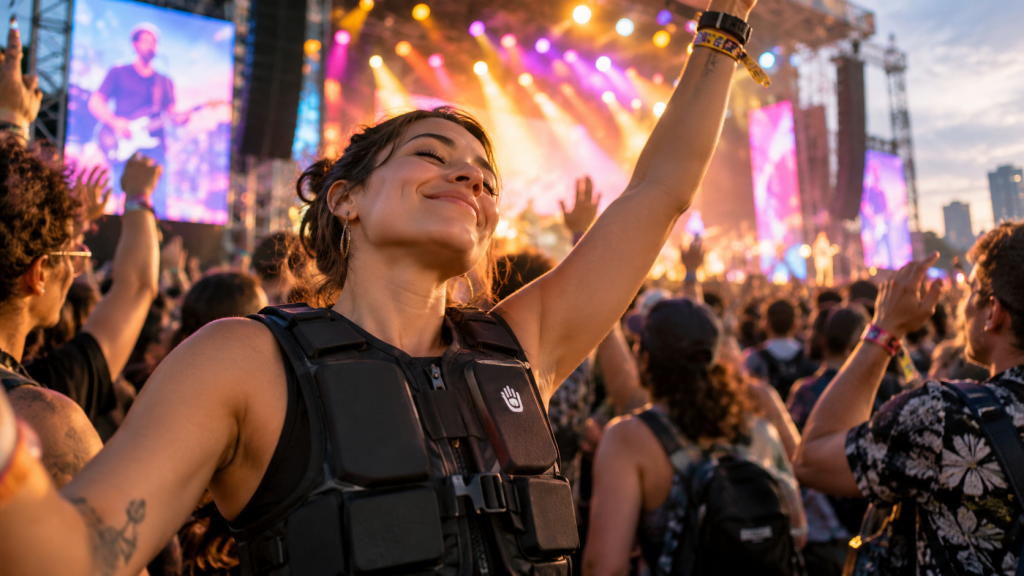
Music is usually described as something we hear. Anyone who has stood close enough to a concert speaker knows that description is incomplete.
Bass is physical. Drums move air. A nightclub floor vibrates. A crowd reacting together creates a sensation that reaches the body as much as the ear.
Technology is beginning to use that physical dimension of sound in increasingly deliberate ways, creating new possibilities for Deaf and hard-of-hearing audiences.
Haptic wearables translate audio into patterns of vibration across the body. Instead of attempting to reproduce hearing, they provide another route into rhythm, intensity and atmosphere. Vodafone and Music Not Impossible previously demonstrated one such system at a live festival, using wearable suits that delivered vibration across multiple points on the body.
That technology remains far from standard concert equipment, but the idea behind it is important. Accessibility does not always need to mean reconstructing one experience as closely as possible. Sometimes it can create another experience entirely.
Captions provide access to words. Sign language interpretation can communicate lyrics, meaning and emotion. Visual production communicates rhythm and atmosphere. Haptics add touch. Together, these tools suggest something more interesting than a single substitute for hearing. They suggest that a live performance can have multiple ways in.
That matters because concerts are social experiences as much as musical ones. People go because of the artist, but they also go because friends are going. They go for the anticipation before the lights drop, for the crowd and for the sense of being present when something happens.
This is why accessibility in entertainment should not be dismissed as secondary. Disability conversations understandably focus heavily on employment, healthcare, housing, education and transport. These are fundamental. But a person’s life cannot consist only of the things required to remain alive and economically productive.
People need fun. They need music, art, sport, holidays, restaurants, films and nights out. A society can provide excellent access to an office and still offer a strangely narrow idea of what inclusion means if everything after working hours remains difficult.
There are encouraging signs that this broader definition of accessibility is gaining ground. The V&A Dundee’s Design and Disability exhibition, running until October 2026, presents work across fashion, architecture, art and design, with particular emphasis on contributions led by Disabled, Deaf and neurodivergent designers themselves.
That matters because disability design is often discussed only in terms of solving a deficit. The person cannot do something, therefore a device is invented. Culture works differently. The most interesting accessible design may not simply compensate. It can create new forms of experience.
Haptic music illustrates this well. A vibration across the torso is not hearing, nor does it need to pretend to be. It is another sensory interpretation of the same performance.
That concept already feels completely normal in other forms of entertainment. Video-game controllers vibrate when a car hits the edge of the track. Phones use haptic feedback to communicate information. Virtual-reality developers increasingly experiment with tactile systems.
Nobody suggests those technologies exist only because hearing or sight has failed. They are designed to make experiences richer.
There is no reason music haptics should be thought about differently.
That does not mean the technology is ready for every venue. Wearable systems can be expensive. They require maintenance, cleaning, charging and technical support. Different users may prefer different levels and patterns of vibration. Some Deaf people may have no interest in haptic devices whatsoever and prefer captions, interpreters or simply the existing physical sensation generated by a large sound system.
Accessibility works best when it increases choice rather than creating a new assumption about what every disabled person should want.
Scale will also matter. A technology available at a major festival or opera house is encouraging. Its real impact will be larger when mid-sized venues, community performances and smaller events can afford similar systems.
The interesting possibility is that this technology may eventually move beyond disability-specific use altogether. Haptic music might simply be enjoyable. A hearing concert-goer may find that feeling particular instruments or crowd reactions adds something to the performance.
If that happens, a technology developed partly around accessibility will have crossed into mainstream experience. That would not be unusual. Many of the world’s most useful design ideas have travelled that route.
The better question is no longer, “How do we help Deaf people experience the concert that everybody else is experiencing?”
It may be, “How many different ways can a human being experience this concert?”
That is a much more generous design question.
Sources
Vodafone, 5G haptic suits and live music accessibility.
Vodafone UK, “5G gives deaf and hard-of-hearing fans a first-of-its-kind live music experience.”
V&A Dundee, Design and Disability exhibition, 2026.