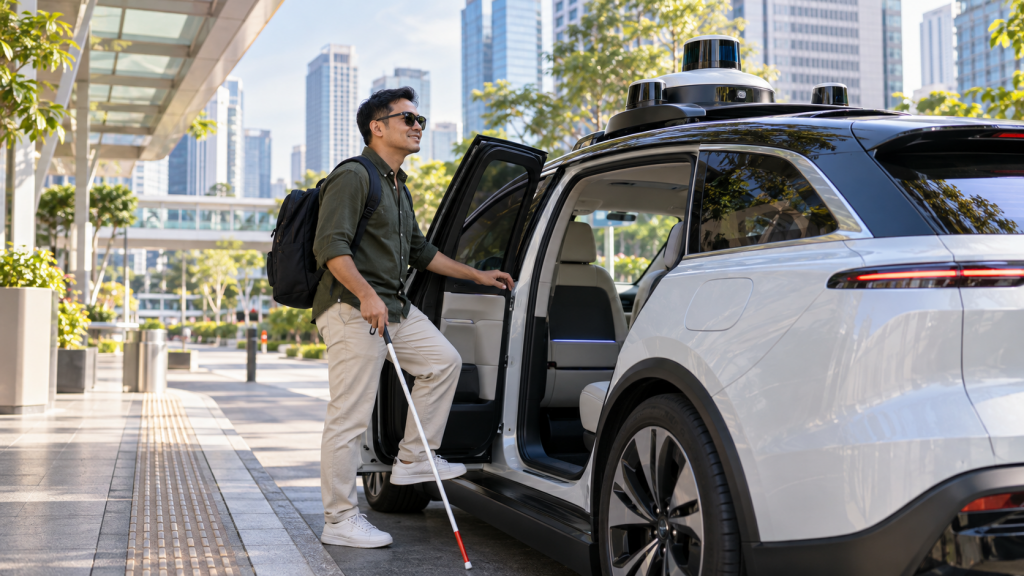
For most people, getting into a car is an unremarkable act. You decide where to go, pick up the keys and leave. For somebody who cannot drive because of blindness, limited mobility, epilepsy or another disability, that ordinary freedom may still depend on somebody else being available: a relative, a friend, a taxi driver or a transport service. The destination itself may be completely accessible, yet reaching it remains the obstacle.
This is why the rapid development of autonomous vehicles deserves attention from the disability community. Not because driverless cars are about to solve transport accessibility, and certainly not because the technology has reached anything close to universal availability, but because it could eventually change one of the most fundamental relationships many disabled people have with mobility: the need for another person to be behind the wheel.
That possibility is no longer purely theoretical. In June 2026, Waymo opened its fully autonomous ride service to the general public in Nashville. In announcing the expansion, the company quoted James Brown, president of the National Federation of the Blind of Tennessee, who described autonomous travel as a level of independence he had not previously experienced because every journey had always depended on another person. Waymo
It is an appealing vision. But the more useful question is what has to happen between today’s robotaxi and a genuinely accessible autonomous transport system.
Waymo already offers a number of accessibility features. Blind and low-vision passengers can use screen readers and audio, visual and haptic guidance to locate their vehicle. The app can make the car play a melody or sound its horn at pickup. Passengers can choose more detailed spoken announcements, while Deaf and hard-of-hearing riders receive trip updates visually on the vehicle’s screen. There is also a setting intended to minimise walking by arranging pickup on the same side of the street where possible. Google Help
These details matter because autonomous mobility is about considerably more than removing the driver. A passenger still needs to locate the vehicle, know that the correct car has arrived, enter it safely, understand what it is doing and have a reliable way to get help when something unexpected happens.
For wheelchair users who cannot transfer into a conventional seat, today’s system is less complete. Waymo does provide wheelchair-accessible vehicle services in several locations, but those vehicles are currently manually driven rather than autonomous. Drivers assist with entering and exiting the vehicle and securing the wheelchair and passenger. Google Help
That distinction exposes one of the hardest engineering problems in the entire idea. A human driver currently does many small things that rarely appear in demonstrations of autonomous driving: positioning a ramp, checking a wheelchair is secured, noticing that a passenger is struggling with a door, dealing with luggage, or realising that the intended drop-off point is unusable. Removing the driver means either designing vehicles that passengers can use independently or developing systems capable of providing that assistance another way.
That is considerably harder than teaching a car to stay in its lane.
There are other complications. Autonomous vehicles still operate within defined service areas. Weather, road design and regulation determine where they can function. Users generally need smartphones and sufficient digital confidence to summon a vehicle. Pricing will also matter. If autonomous transport becomes an expensive premium service, its potential to widen independence will inevitably be limited.
Then there is trust. Disabled people are often asked to trust systems that were not originally designed around them. An autonomous vehicle will earn that trust through fairly unglamorous things: reliable pickups, understandable interfaces, responsive support, doors that work properly, clear emergency procedures and the confidence that a journey will not suddenly become a logistical problem halfway through.
The impressive technology may be the self-driving system. The technology that determines whether somebody actually uses it may be the accessible app and the emergency support button.
There are nevertheless reasons for optimism. Waymo’s newer Ojai vehicle, introduced in 2026, includes accessibility features such as embedded Braille, screen-reader compatibility and a seat-integrated handle intended to help people entering and exiting the car. The company says these were developed with input from riders and community partners rather than treated purely as later additions. Waymo
That approach matters. Autonomous transport designed around an imaginary “standard passenger” and adapted later is likely to repeat familiar mistakes. Designing it around a broader range of bodies, senses and mobility needs from the beginning creates the possibility of something considerably better.
There is also a useful question for countries such as Malaysia. Fully autonomous robotaxis are not about to become an everyday feature of Malaysian streets, but it is precisely before a technology becomes entrenched that some of the most important decisions can be made. When autonomous fleets eventually reach more markets, will wheelchair access be treated as standard infrastructure or a specialist add-on? Will interfaces support different sensory needs? What happens when a passenger cannot physically use the standard vehicle? What obligations should autonomous transport operators have toward accessibility?
These questions are easier to answer before millions of vehicles are already on the road.
The greatest promise of autonomous transport is therefore not that people will be able to sit in the back seat while a computer handles the tedious part of driving. For some disabled people, it is much more fundamental. It is the possibility of deciding to go somewhere without first deciding whom to ask.
A doctor’s appointment. Dinner with friends. Work. The supermarket. Somewhere entirely unnecessary on a Sunday afternoon.
That is what genuine mobility looks like.
Autonomous transport still has a long way to travel before it provides that freedom equally. Yet the technology is beginning to make us imagine something that once sounded improbable: a car in which being unable to drive does not necessarily mean being unable to go.
Sources
Waymo, Nashville public autonomous service launch, 25 June 2026. Waymo — Nashville launch
Waymo, Accessibility Features. Waymo — Accessibility Features
Waymo, Wheelchair-Accessible Vehicles. Waymo — Wheelchair-Accessible Vehicles
Waymo, Ojai accessible autonomous vehicle platform. Waymo — Ojai vehicle