JULY 2026
Housing conversations are usually dominated by price, location and size. Accessibility still arrives too late, often only after illness, injury or age forces the issue. That is beginning to change, and not a moment too soon.
Most people do not think about accessibility when they first imagine a home. They think about light, neighbourhood, layout, maybe a decent kitchen and enough room to breathe. Accessibility is often filed away as a specialised concern, something relevant only to a clearly defined minority or to some later stage of life.
That instinct is understandable. It is also one of the reasons so much housing remains harder to live in than it should be.
A good home is not simply one that looks attractive or sells well. It is one that can accommodate the body as it actually changes over time. It should remain usable after injury, during illness, through ageing, with a pram, with a wheelchair, with fatigue, with reduced grip strength, with a temporarily broken foot, with a parent visiting, with a child growing, with all the ordinary unpredictability that a real life contains.
Seen that way, accessible housing is not a niche category. It is simply housing designed with a better grasp of reality.
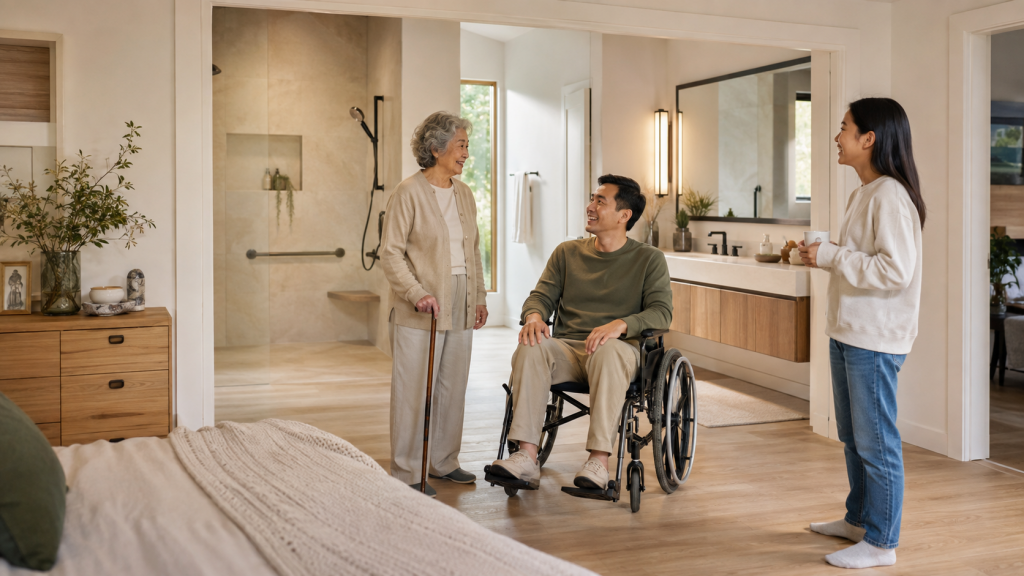
This is why universal design has become such an important idea. AARP’s recent guidance describes the universally designed home not as a medicalised space, but as one that includes features such as no-step access, wider doorways, usable bathrooms and layouts that support movement without unnecessary strain.[1] These are not strange or extravagant additions. They are sensible design choices. The problem is that they are still treated as optional.
The supply gap remains stark. In a 2025 article on disability-forward design, the National League of Cities noted that while 26% of people in the United States have a disability, less than 6% of housing is accessible.[2] Even allowing for differences across countries, the broader lesson is hard to ignore: housing markets have not kept pace with the realities of disability, ageing and everyday mobility needs.
Part of the difficulty is perception. Accessible housing is still often imagined in overly clinical terms: grab bars, hospital colours, institutional fittings, visible compromise. In truth, the best accessibility features are often the least dramatic. Good lighting. Clear circulation space. Handles that are easy to use. Threshold-free entrances. Bathrooms that do not become hazards when balance changes. Kitchens that can be reached and navigated without strain. These are features of dignity, not deficiency.
There is also a practical case that developers and policymakers have been slow to embrace. Homes built or renovated with more adaptable features tend to serve more people for longer. They support ageing in place. They reduce the need for costly later retrofits. They make life easier for families, guests and caregivers. They are more forgiving of the simple fact that bodies do not remain static.
This is not new wisdom. HUD materials on universal design and residential remodelling have for years stressed the importance of eliminating common barriers such as narrow doorways, poor lighting, steps at entrances and badly placed controls.[3][4] Yet the market still behaves as if these insights belong to specialist literature rather than mainstream planning.
There are reasons to think the conversation is maturing. More designers now understand that accessible homes do not need to look compromised. Good materials, beautiful finishes and thoughtful accessibility can coexist perfectly well. More local governments are experimenting with visitability and universal design standards. More families are beginning to recognise that a home that works across different stages of life is not only kinder but wiser.
The change, however, needs to go further. If accessibility is always treated as a premium add-on, it will remain scarce. The real gains will come when housing policy, building codes, financing and planning incentives start to reward homes that are easier to live in from the outset. A no-step entry should not feel radical. A bathroom that can actually be used safely should not feel like specialist luxury.
There is also a cultural adjustment required. People often resist accessible design because they assume it announces vulnerability. In fact, it does the opposite. It gives people more room to remain in control of their own lives. It makes a home more resilient to change. It reduces the chance that life’s next challenge turns a familiar space into an obstacle course.
That is why accessible housing deserves to be discussed less as charity and more as foresight.
The hopeful part of this story is that the design language is improving. Universal design is no longer confined to obscure professional corners. It is entering conversations about liveability, ageing, family life and future-proofing. That broader appeal is useful. It helps move accessibility out of the category of special pleading and into the category of common sense.
In the years ahead, housing markets will be under growing pressure to respond to older populations, tighter urban living and a more honest understanding of disability. The smartest response will not be to build separate homes for separate kinds of people. It will be to build more homes that can absorb difference gracefully.
That is the promise of accessible housing at its best. Not a home that advertises special needs, but a home that respects ordinary human variation from the beginning.
And once you begin to see it that way, the old model starts to look oddly limited. A house that only works well when the body behaves predictably is not especially well designed after all.
It is simply unfinished.
Source notes
[1] AARP, “Universal Design: An Introduction” (2025). https://www.aarp.org/livable-communities/housing/info-2025/universal-design-introduction.html
[2] National League of Cities, “Disability-Forward Design Across Multiple Cities” (27 January 2025). https://www.nlc.org/article/2025/01/27/disability-forward-design-across-multiple-cities/
[3] HUD User, “Residential Remodeling and Universal Design” (U.S. Department of Housing and Urban Development). https://www.huduser.gov/portal/publications/destech/resid.html
[4] HUD User, “Homes for Everyone: Universal Design Principles in Practice” (U.S. Department of Housing and Urban Development). https://www.huduser.gov/portal/publications/destech/unidesig.html